
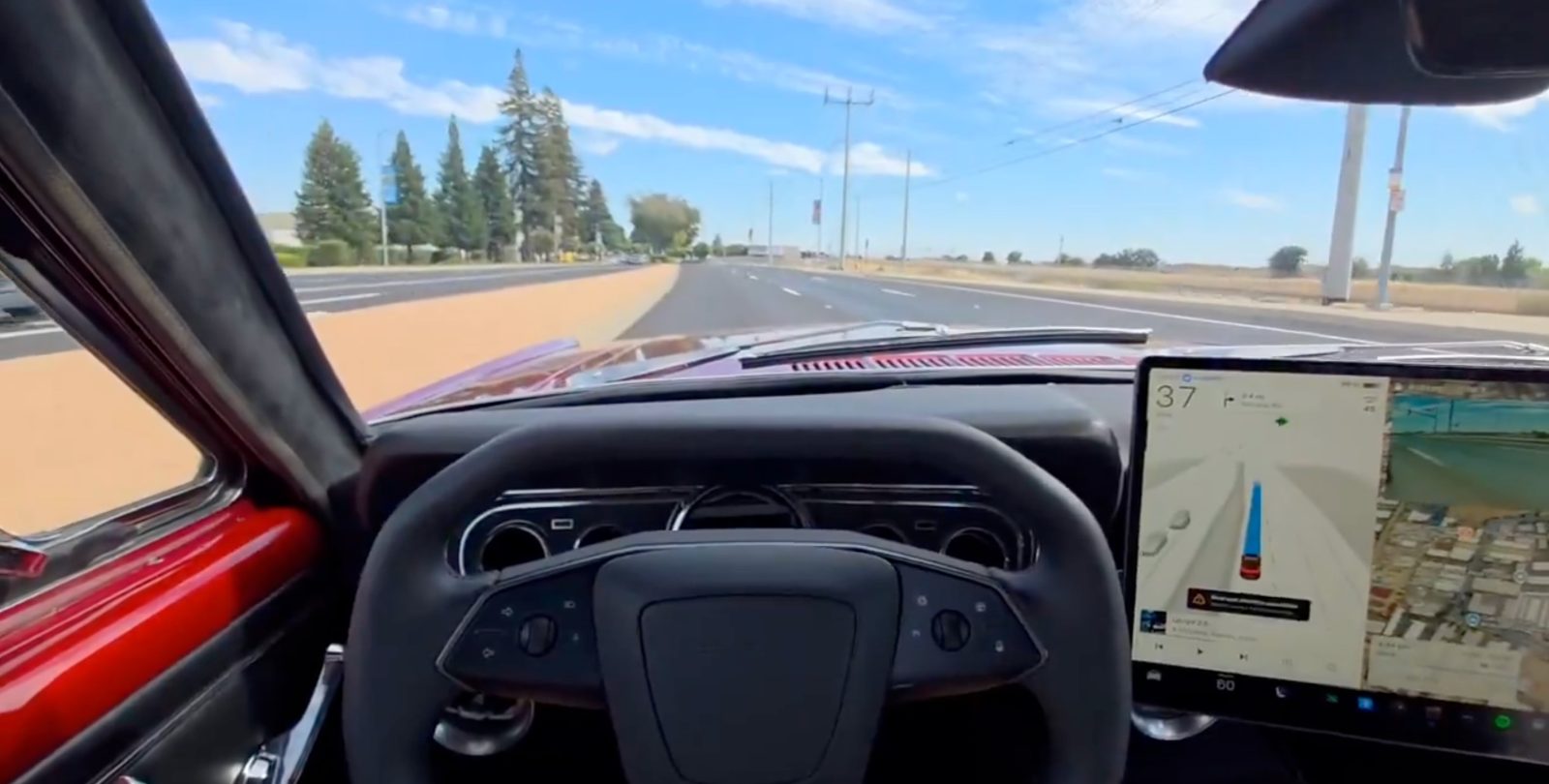
A Tesla auto parts shop owner in Sacramento spent about $40,000 and two years converting a 1966 Ford Mustang into a fully functional Tesla — complete with the Model 3’s dual-motor drivetrain, 15-inch touchscreen, and working “Full Self-Driving” (Supervised).
It’s likely the first non-Tesla vehicle to run FSD, and it achieves 258 Wh/mi — roughly matching the efficiency of an actual Model 3.
From Facebook Marketplace find to Tesla-powered classic
Yaro Shcherbanyuk, the owner of Calimotive Auto Recycling in Rancho Cordova, California, found the 1966 Mustang on Facebook Marketplace in the summer of 2022. Calimotive specializes in Tesla and Rivian parts, so Shcherbanyuk had access to the components — and the knowledge — needed for an ambitious build.
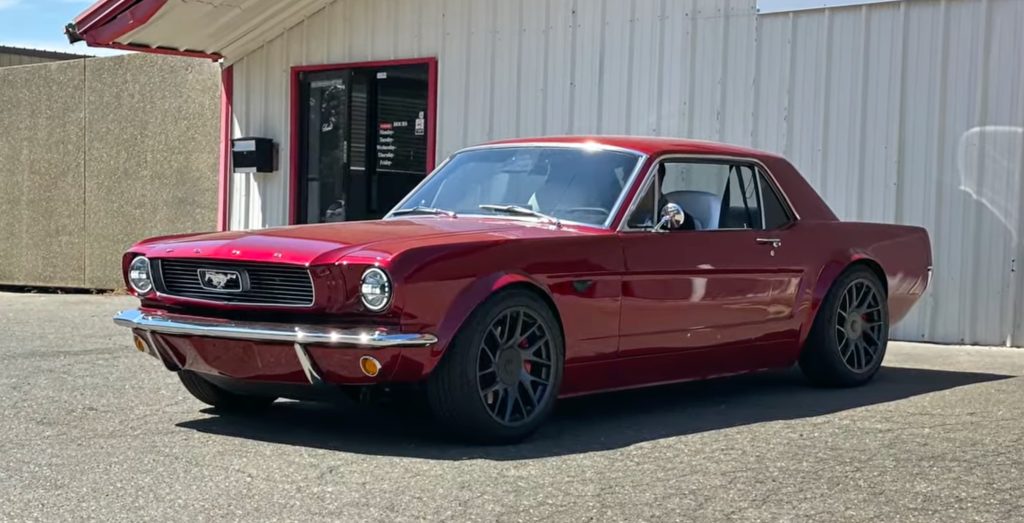
He worked on the project for roughly two years alongside his father Viktor and brother Daniel. The family initially considered fitting the Mustang with a Model S drivetrain, but once the car was stripped down, Shcherbanyuk realized the Model 3 battery was nearly a perfect fit.
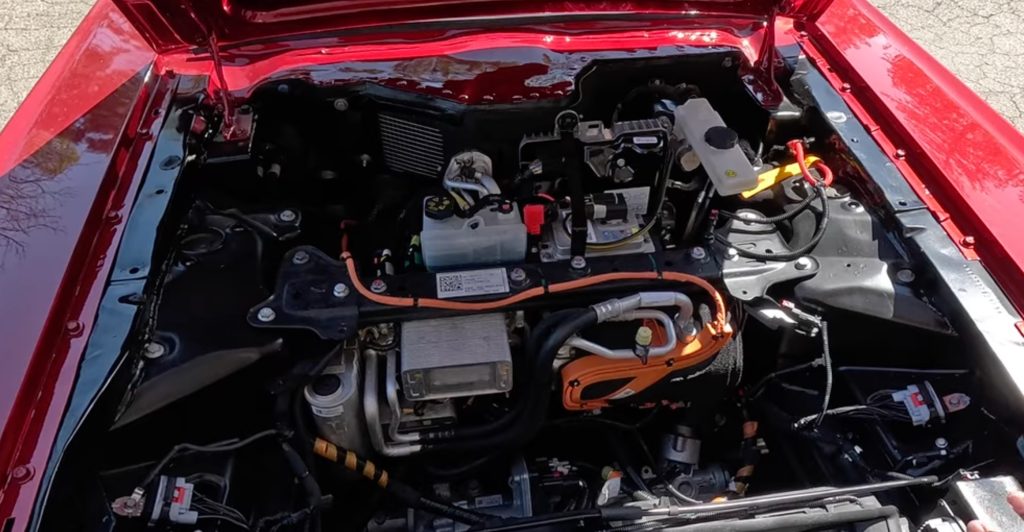
The team grafted three sections of the 2024 Tesla Model 3’s floor and seats into the Mustang’s body, shortening the battery case to fit without altering the car’s original dimensions. The result is a classic Mustang shell sitting on top of a Model 3 dual-motor setup good for roughly 400 horsepower and 471 lb-ft of torque — enough to push it from 0-60 mph in about 3.5 seconds.
‘Full Self-Driving’ in a 60-year-old car
The most remarkable part of the build isn’t the drivetrain — it’s the software. Shcherbanyuk retrofitted Tesla’s camera array onto the Mustang, enabling Autopilot, Sentry Mode, and “Full Self-Driving” (Supervised). The system reportedly works, making this what appears to be the first non-Tesla vehicle to actually run FSD.
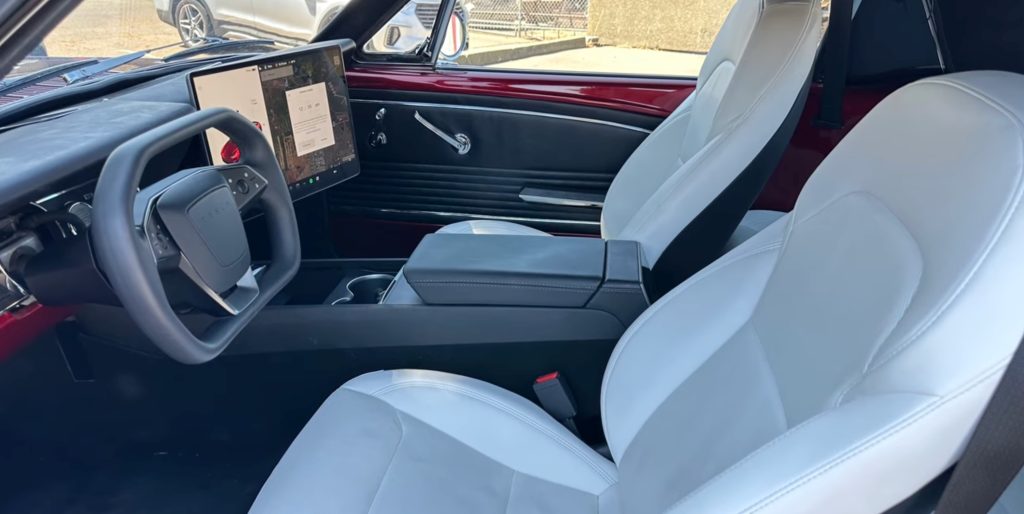
Inside, the Mustang features the Model 3’s 15-inch touchscreen controlling all vehicle functions and receiving firmware updates over the air. Shcherbanyuk also installed the Cybertruck’s yoke steering wheel and Tesla-sourced heated and cooled seats. The Tesla charging port sits where the original gas cap was at the rear of the car.
Here you can see the car using Tesla’s Summon feature:
During a test drive with Business Insider, the car showed 194 miles of range remaining at approximately 80% battery. Shcherbanyuk reported achieving 258 watt-hours per mile, which matches or beats the efficiency of a standard Model 3 — impressive given the Mustang’s less aerodynamic body.
Why this matters beyond the novelty
The build is a passion project, but it highlights a few things about the state of Tesla’s technology. Elon Musk has talked about licensing “Full Self-Driving” to other automakers for years, but no manufacturer has signed a deal. Ford CEO Jim Farley publicly shut down the idea, saying Waymo’s system is superior. Musk admitted last year that legacy automakers simply don’t want FSD.
Yet here’s a small auto parts shop in Sacramento running FSD on a non-Tesla vehicle for under $40,000 in total project costs. It demonstrates that Tesla’s hardware and software stack is more portable than the company’s licensing struggles would suggest.
The project also speaks to the growing EV conversion market, where Tesla drivetrains have become the go-to for classic car builds. Companies like Arc Motor Company offer Tesla-battery-based classic car conversions starting at $75,000, making this $40,000 DIY build look like a bargain by comparison. The global vehicle conversion market was valued at $5.9 billion in 2024 and is projected to grow at 9% annually through 2034.
Top comment by John K
That's an amazing achievement considering the camera placement differences. I would take issue with this statement though
Shcherbanyuk reported achieving 258 watt-hours per mile, which matches or beats the efficiency of a standard Model 3
I drive a dual motor Model Y, (not as efficient as a "3", rated at 15% higher consumption), and have averaged 241 watt-hours per mile for 23,700 miles in Massachusetts and nearby states. I'd expect 210 if I had been driving a Model 3.
Here’s a cool walkthrough of the car:
Electrek’s Take
This is one of the coolest EV conversion projects we’ve seen. Getting a Tesla Model 3 drivetrain into a classic car isn’t new — we’ve covered Tesla-powered builds ranging from Shelby Cobras to Honda Accords over the years — but getting “Full Self-Driving” working in a 1966 Mustang is a first, and it’s genuinely impressive.
The most impressive part, in my opinion, is getting Autopilot and FSD to actually work with what are inevitably different camera angles throughout the entire sensor suite. Tesla’s vision-based neural network was trained on data from cameras mounted in very specific positions on Tesla vehicles. The 1966 Mustang has a completely different body shape, roofline, and mounting surface geometry — meaning every single camera in the suite is sitting at a different angle and height than what the system was designed for. The fact that FSD still functions despite that is a testament to the robustness of the neural net, and it tells us something useful about how adaptable Tesla’s vision stack actually is to non-standard camera placements.
That’s relevant if Tesla ever does manage to license FSD to other automakers with different vehicle geometries – something it has tried to do for years, but it has yet to convince an automaker to get on board.


FTC: We use income earning auto affiliate links. More.


Comments